
Journey
I wrote about a train journey. And the journey of LIFE. So this title is extremely sophisticated, as I'm sure you can understand.

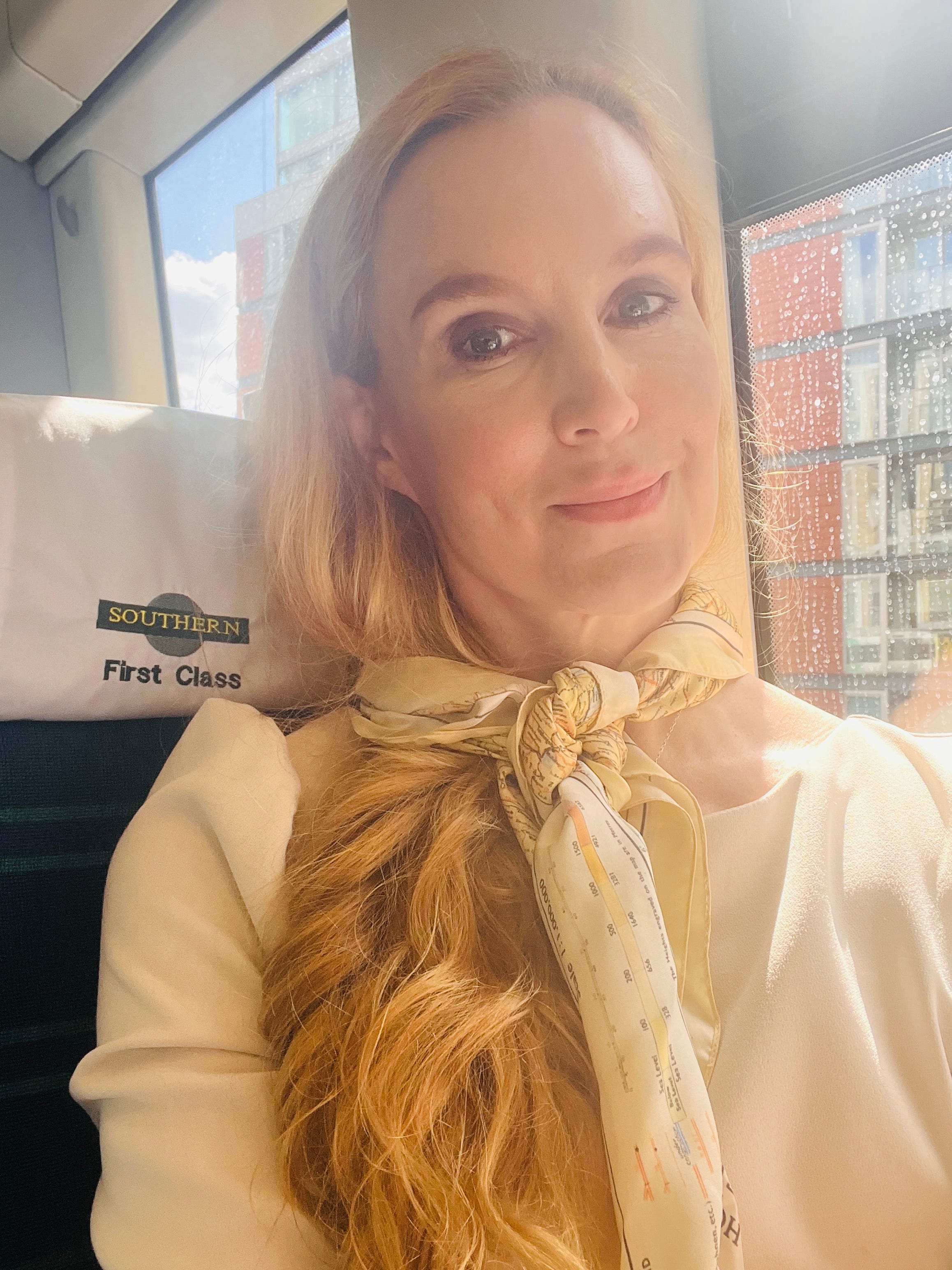
This week, I have a two day studio residency to complete, a half hour drive from the town where I grew up as a (not especially willing) member of an apocalyptic religious sect. The day before, I’ve got meetings in central London, so I’d planned to park my car somewhere outside the M25 and take a train in for the night. As I surveyed my options, it suddenly occurred to me that what I’d really like to do, is to park at the station that used to be my local station, and take the train into London from there. Writing my second book, DIRTY, has made me nostalgic, and I want to retrace the route I took in and out of London all through my childhood and teenage years. For theatre trips, and for visiting my aunt and uncle in Isleworth, and for adventures to the Natural History Museum. For my (failed) audition at the Royal Ballet School, and then Saturday dance classes, followed a few months later by drama school auditions, and finally, my move to London to begin my training in classical theatre. My early life was by no means an unmitigated delight, but the parts of it that involved train journeys were mostly pleasant, I think. I book a train, plan a travelling outfit, and wait to find out what my memory will serve up to me on the journey. If I sit in a train carriage for the hour it will take me to travel the familiar route, what will I remember?
****
A week later, on platform two of the station belonging to my long ago hometown, the first thing I recall is the old metal vending machine that used to be fixed to the wall on platform four. It served chocolate bars in shiny tin foil and purple paper — Dairy Milk, I think, and Cadbury’s Fruit and Nut. We’d been waiting on the platform, our whole family of four, and I’d had hopes, regarding the vending machine across the tracks from us. The idea of chocolate bars, offered up by machine, was entirely entrancing to me. I’d never had my own chocolate bar, and had most certainly never been bought one from one of these gleaming, dented, wall-mounted silver boxes. “Could we walk over the tracks and buy one?” I asked, with great anticipation. The train was almost due, so I knew there’d be no time to take the stairs and cross the footbridge. This seemed a reasonable alternative, but to my great annoyance, everybody burst into laughter at the suggestion. My parents, certainly, and probably my sister too, but to my dignity-requiring, pre-school self, it felt as though far more than three people were laughing at me. The British Rail employees, probably. Maybe other passengers waiting on the platform. The problem with being very young, for me, was that I hadn’t really understood that I was a child. It didn’t occur to me that my question had perhaps been funny in an endearing kind of way. I thought everyone (EVERYONE) was laughing the way you’d laugh if the Prime Minister was suddenly revealed as unable to do his three times table, or to distinguish between a fireman and an elephant. Laughing because I was idiotic.
I, of course, being made to feel idiotic, did exactly what any Prime Minister would do if his dignity was publicly offended in this manner. I burst into tears. My question had been perfectly serious, and now I wasn’t going to get any vending machine chocolate and I felt stupid. Greedy, too. I did not like having been revealed to be someone so unduly preoccupied by confectionery as to want her father to risk being run over by a train in order to satisfy her sugar cravings. Later, my parents bought a bar of chocolate for me to share with my sister by way of apology, and I appreciated the gesture, but the shame remained. My preschool years are littered with memories like this — forests of towering, laughing adults, surrounding a version of me who desperately wished to be taken seriously, like the adult that I hadn’t realised I was not.
Now, I sit on a bench on the platform, waiting for the train, looking at the rails, and eating liquorice allsorts from my handbag. Nothing much has changed in some ways. I’m 49 now, but I’m still passionately attracted to confectionery. I still don’t want to be laughed at, especially by anyone bigger than me. Fortunately, no one is bigger than me, any more. The line begins to hum. I stand up and gather my belongings. I wonder if I shall remember the order of the station stops on the way to London.
****
I lift my suitcase into the luggage rack above my head, and I am eighteen again, taking the train back to drama school after my first exhilarating week of being an actor. I’d travelled home for the weekend to collect more clothes, and my dad accompanied me onto the train, to lift my suitcase into the rack above my seat. I couldn’t do it for myself — early that summer I’d awoken one morning with a lower back that had suddenly and completely stiffened up, as though set in concrete overnight. As a teenager who’d spent all my free time in ballet and gymnastics lessons, I’d at first been entertained to finally have an injury, because I assumed I’d recover — it felt like a minor right of passage, for an athlete. But as the summer had crawled onward, I’d discovered, with worry and then anxiety and then panic, that the injury I’d acquired wasn’t the entertaining, temporary kind. My drama school was in the process of transferring me from the dancers’ course to the actors’ one, since I certainly couldn’t dance any more, but I was beginning to discover there was a raft of things I also couldn’t do any more, unless I wanted to risk additional pain and further injury. Like running, or carrying my five year old brother. Like lifting a suitcase above my head.
I no longer touched my father or let him touch me, so I didn’t hug him as we said goodbye and he disembarked the train, but as it set off towards London, I did worry about how I was going to get my suitcase down again at the end of the journey. I was over six foot tall, and the muscles I’d built through hours of gymnastics every day were only just beginning to soften. No one would expect me to need help. And I certainly wasn’t equipped to ask for it. I’d used up all my social courage the previous week, trying to learn how to talk to people at a college full of glamorous extroverts. I sat and worried about my suitcase, and my back. Once, I’d been a small child who felt like an adult. Today, at eighteen, I was a newly-minted adult who still felt childish. The world seemed far too difficult.
****
We stop briefly at the station belonging to the larger town next to ours, where I’d attended the sort of secondary school that managed to resemble both prison and zoo in a number of unpleasant ways. I’d managed to survive two years there, but still, I was always nervous when the train stopped here — the possibilities regarding who might get onboard were unpleasant to contemplate. Now, I was a second year at drama school, and more confident than I’d ever been before, but still, I was glad that no one got onto the train. On the platform, a group of boys of about my age seemed to be engaged in an argument. Just as the train began to move again, one of them suddenly lunged forward, and head-butted the smallest boy. He fell backwards, rigid as a falling tree, and sprawled onto the platform tarmac, out cold. My phone was in my hands before I realised it. I’d never called 999 before, and my hands shook as I asked for the police, then began to describe the scene I’d witnessed, and the identifying characteristics of the boy who’d attacked the other. Afterwards, I gazed out of the train window as we raced towards London. I discovered that I was crying. I’d never seen someone deliberately knocked out in real life before. The human body was so fragile outside of fiction — not at all like Rocky’s, or Arnie’s, or Indiana Jones’. And the other boys had laughed before they’d scattered, towards the station exits. Like hurting him was a joke. This town had a sickness. I wanted to never return.
****
The glorious possibilities of the airport. I’d travelled through it hundreds of times, but had never disembarked. I always watched the people who did leave the train here, lugging baggage with labels attached, dressed for warmer weather, or skiing, or business. I longed to be them all. I’d have flown anywhere that wanted me. But most of all, to America. My best friend had told me that on her parents’ wedding day, her father had insisted that they come to this airport to watch the planes take off, as a celebratory end to their special day. It had been the beginning of what would become a catastrophic marriage. I’d listened sympathetically, and giggled over her oblivious father and irritated mother, but secretly, I thought I’d have liked to watch the planes too. Seeing them on the actual runway would be magic.
****
We’ve pulled in at the ballet shoe station. I’d needed a pair of pink satin ballet shoes for a show my ballet school was putting on. The shop’s owner had come to our school to fit all the students, but she hadn’t expected me, the surprise six foot tall ballerina. “Size 8!” She’d marvelled, in the stupid way that small women always did, on discovering my shoe size. As though it would have been in any way reasonable for me to have had small feet, at my height. As though despite spending her whole adult life selling shoes, the idea of big feet was a novel one for her. The other girls, all shorter, had presented her with no challenge, but there were no shoes for me. So she’d told my mother to bring me to the shop, a little annex built into the station building itself, to be fitted. Despite my irritation with the shop’s owner, I’d loved it — the space was tiny, almost all window really, and absolutely full of ballet shoes, from floor to ceiling. The smell of satin, leather and canvas, and the colour pink everywhere. Here, with no audience to play to, the proprietor confined herself to selling us a pair of size 8 satin slippers, with pale pink elastic straps to stitch on later. I hoped, when it was time to graduate to pointe shoes, that there’d be some big enough for me. I didn’t even dare to dream that I might be able to purchase them without a stupid fanfare about the size of my feet. I didn’t know yet that once I was an adult, no one would be so insulting towards a paying customer. If they didn’t have shoes in my size, they would apologise, and order some to be collected later. Having discovered this, I will never stop being grateful for the blessing of adulthood. Now, I buy ballet shoes regularly, but never from here. I’m a tremendous grudge-holder, but even if I wasn’t, the shop no longer exists.
****
When she was eighteen, my vital older sister Immi moved to London, to volunteer for a church organisation. We’ve just pulled into the station where I’d alight the train on the generous occasions upon which she’d summon me to spend the weekend with her. These weekends were everything. I missed her endlessly, the way you miss sunshine at the beach when it’s blocked out by clouds, and spending time with her away from our family home was beginning to show me the possibilities of the future, adult, relationship-of-equals that we’d enjoy, later. Not that we were equals yet. I was fourteen, and Immi would meet me at the ticket barrier, because even the five minute walk to her flat would have felt impossibly intimidating to me. London to us, at that age, meant three things — Leicester Square, Hyde Park and Harrods. We went to Harrods to look at the rich people’s clothes and to buy barely-affordable items from their bakery. At Leicester Square we bought £1 slices of pizza and went to see films I wasn’t quite old enough for. And in Hyde Park, one warm afternoon, we sat on the grass and had the first conversation we’d ever achieved, about what was wrong at home. We wouldn’t use the word ‘abuse’ for thirty more years, but still, the conversation will live with me always, because we were together, a hundred miles from the abuser, and I felt safe enough to tell Immi how things were, without her. Together, we felt emboldened to describe, then criticise, and then even laugh at some of what we’d witnessed, what we’d experienced. There, on the grass, we made a pact. It is one that we have never broken.
****
We have reached the train’s terminus and I walk along the platform towards the barrier, next to a brick wall with dirty white concrete pillars spaced at regular intervals along its length. The past crashes in, a series of pictures so vivid that they almost obscure the 2026 reality before me. At eighteen, I’d come to London for the day, determined to tell homeless people about Jesus, and to provide them with food with which to make my evangelism more palatable. It was 1995, and I’d wandered around London all day, unable to actually find any homeless people to save. I’d eaten several pieces of my home-baked apple pie myself, morose with the thought that I might not be cut out for evangelism after all. Eventually, as I’d walked down this very platform, on my despondent return home, I’d spotted an actual homeless man, full equipped with sleeping bag and grubby knapsack. I was delighted. “Would you like a piece of apple pie?” I accosted him, hoping this was the beginning of his Moment of Salvation. He looked rather suspicious, and not especially willing. “Alright.” He replied, and I handed him two pieces, plastic wrapped, rather squashed from their gloomy day-long pilgrimage. It was then that I realised I had not the least idea of how to introduce the topic of Jesus — suddenly, I perceived him to be a subject entirely separate from apple pie. Simultaneously, I discovered that the homeless man was trying to look up my (unwisely short) skirt. I decided to return to evangelism when I was perhaps a little older. It was more difficult than I’d anticipated, and my costuming would need more thought.
****
Back in 2026, it is the end of my visit to London. I’ve had a glorious dinner at Simpson’s in the Strand with my anonymous political friend, and a hilarity-fuelled, top-speed lunch at The Ivy with another, only slightly less political friend. I’m feeling satiated, and happy, and rather weary. I’m looking forward to spending the train journey back to my car engrossed in writing. A cheerful-looking gentleman with an excellent moustache smiles at me as I sit down in a seat opposite him. I pull my laptop out, and wonder if I’m in the correct half of the train. It divides mid-way through the journey, which always makes me anxious. I decide to move to the next carriage, just to be safe. I never know, when they say the ‘front’ of the train, whether they mean the bit nearest to the ticket barrier, or the bit that’ll form the front when we actually start travelling.
From my new position, I begin to type, and then absently check my phone. I have a Twitter DM. I click on it, and read the following. “I thought that was you on the ___ to ____ train in First Class carriage 4; I’m terribly sorry if you were travelling incognito and I caused you to move carriages, for fear of unwanted conversation.” I am astounded. I hardly ever get recognised, and when I do, whoever it is usually only lets me know when it’s far too late for me to do anything about it. Generally, they post about it on Twitter, and I implore, “If you see me again, do say hello!” But they never do. So I write back, asking if he’d like to join me, and moments later, the gentleman-of-the-excellent-moustache and I are sitting opposite each other again, exchanging business cards and talking nineteen to the dozen. The journey seems to pass almost instantly. I hug my new friend goodbye, collect my luggage, and am back at my car before I can begin to fully absorb the beauty of this triumphant return to my home town. I left here at eighteen, with a new back injury, an archive of trauma not yet processed, and little idea of how I’d ever be able to support myself. With fears of all the people who want to hurt other people for fun. Fears about my own inadequacies, too, and the unlikeliness of my ever being able to afford to fly anywhere by plane. With anxieties about my too-big feet, and whether I’d ever be as good a Christian as my sister.
Thirty years later, I can make new friends in train carriages, with the sort of men who don’t go around head-butting people on railway platforms. I can go to silly expensive restaurants for conversations with people who I chose, and I can purchase myself as many chocolate bars as I want, though I don’t generally allow myself to climb across railway tracks in order to do so. If I see a homeless person, I can buy them food without trying to insert Jesus into the process. I can even ask them what they’d like, rather than deciding for them in the manner of a clueless evangelical eighteen year old. I can wear shoes that I’ve bought without having to discuss my shoe size with anyone, and all of these sweet truths will be made sweeter because my memories of my life before are so sharp, and feel so close. Which is really just as well. My memory is hideously, endlessly vivid.
Even by your high standards, this piece is rather beautiful. As a lifelong railway enthusiast, it really speaks to me.
Perceptive, engaging, enjoyable and evocative. At least in the opinion of this professional writer, who always looks forward to your posts.